The Circles of Decision-Making

Updated: Apr 29
A practical guide for rugby coaches and players who want to build a culture of thoughtful player self-review
Turning video analysis into a player-led tool
Video analysis gives coaches more information than ever before. The footage is there. The moments are tagged. The evidence is clear. The question is not whether to use it, but how to get the most out of it.
One session makes a considerable difference. When a coach narrates a review session, players receive information. When a player works through the footage themselves, they build understanding. Real game intelligence only develops when a player has to find the answers themselves.
The Circles of Decision-Making framework is built around that idea. It gives coaches and players a structured method for using video analysis to drive player self-reflection, putting the thinking where it does the most work: with the player.
The theory: three circles, three levels of accountability
Originally developed by our founder, Jon Moore, the Circles of Decision-Making changes how we use footage to review individual performance. Instead of asking what a player did at a given moment, it asks where they were, what they saw, and whether the decision they made from that position was correct.
”The player can the use visualisation to paint the picture and be the picture.” - Jon Moore

Every players moment in a match, a tackle, a carry, a breakdown, sits at the centre of a set of concentric circles. Each circle represents both a physical distance and a point in time before that moment occurred. Move outward and you move further from the contact, and further back through the player's approach to it.
Using Nacsport's timeline, a coach or analyst tags player moments for individual players and then navigates backwards through the footage, walking the player through each circle and asking them to account for their decisions at every stage.
The three zones have been named to make them workable as everyday coaching language:
Zone 1 - The Contact Circle
The player is at or arriving at the point of primary action: making or receiving a tackle, carrying the ball, contesting the breakdown. This is the only zone where a performance grade is applied, scored 1 (needs attention), 2 (average performance), 3 (good performance) and 4 (excellent performance). The question is straightforward: did they do what they have been coached to do? This numerical scoring adding to the amount of moments can be added together for an overall performance score.
Contributions | Player 1 | Player 2 |
1 | 1 | 3 |
2 | 2 | 4 |
3 | 2 | 3 |
4 | 1 | 3 |
5 | 3 | 4 |
6 | 1 | 4 |
7 | 1 | 2 |
8 | 2 | |
9 | 2 | |
10 | 1 | |
11 | 1 | |
12 | 1 | |
Total/Impact | 18 | 23 |
Key to this will be the balance of moments as the game enters multi phase play, between runs, tackles and contributions at rucks and mauls.
When players consistently hit their contribution targets, the effect on the whole team's performance is significant.
Zone 2 - The Support Circle
The player is within immediate contributing distance, more than five metres out. They are not the primary actor, but their presence and timing directly shapes the outcome. The question shifts from execution to decision: should they commit into Zone 1, or hold their position and influence the next phase?
Zone 3 - The Shape Circle
The player is further from the action. No tackle to make, no carry to complete. Their job is to read the game: scan, process, and position themselves as a useful resource for what comes next. This is where a player's game understanding is most honestly assessed.

The one to five indicated in this diagram represents the questioning to the player of what are the list of things we coach you when you look at this situation, in the proximity and timing of what they see.
The circles have no fixed distance or time. They flex depending on the sport, the phase of play, and the coaching language already in use for that squad. The point is that they give both player and coach a shared vocabulary for reviewing decisions at every stage of a moment, not just the moment itself.
Application: handing the thinking to your players
The primary use is as a player self-review tool. Rather than a coach-narrated debrief, the player works through their own moments using the circle structure as a guide, either independently or with a coach present.
It may be that a combined approach to begin with is necessary for the player to fully understand and get buy-in, but ultimately we want the player to have self access. It’s an opportunity to see if there is agreed understanding and ownership from the player and coaches. It’s really important to have the emphasis on the things that are done well in balance to the things that need attention.
Here is how to set it up:
Build the tagging structure in Nacsport around three player moment categories: Attack (carries, offloads, running lines), Defence (tackles, pressure, alignment), and Ruck and Maul (breakdown involvement). Every instance is tagged to the individual player across their timeline row for the full match.
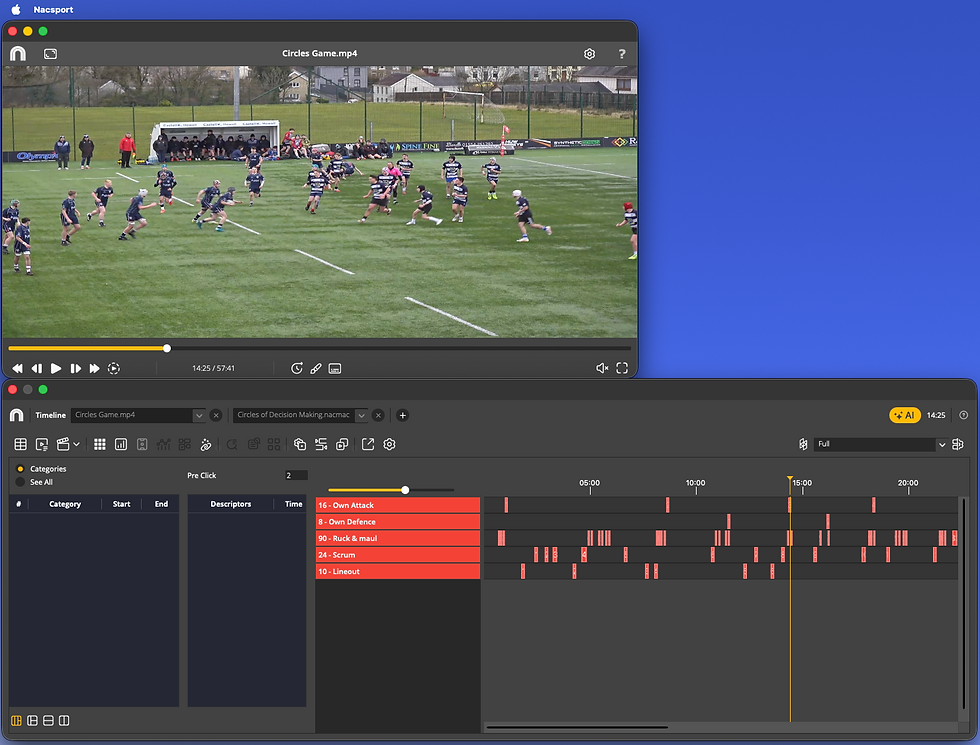
Start with the timeline, not the clips. Before opening any player moments, have the player look at the distribution of their instances. Are there long gaps? Is the ruck and maul row heavy relative to attack and defence? The patterns tell a story about how well a player managed themselves as a resource throughout the match, and they can read it themselves before the coach says anything.
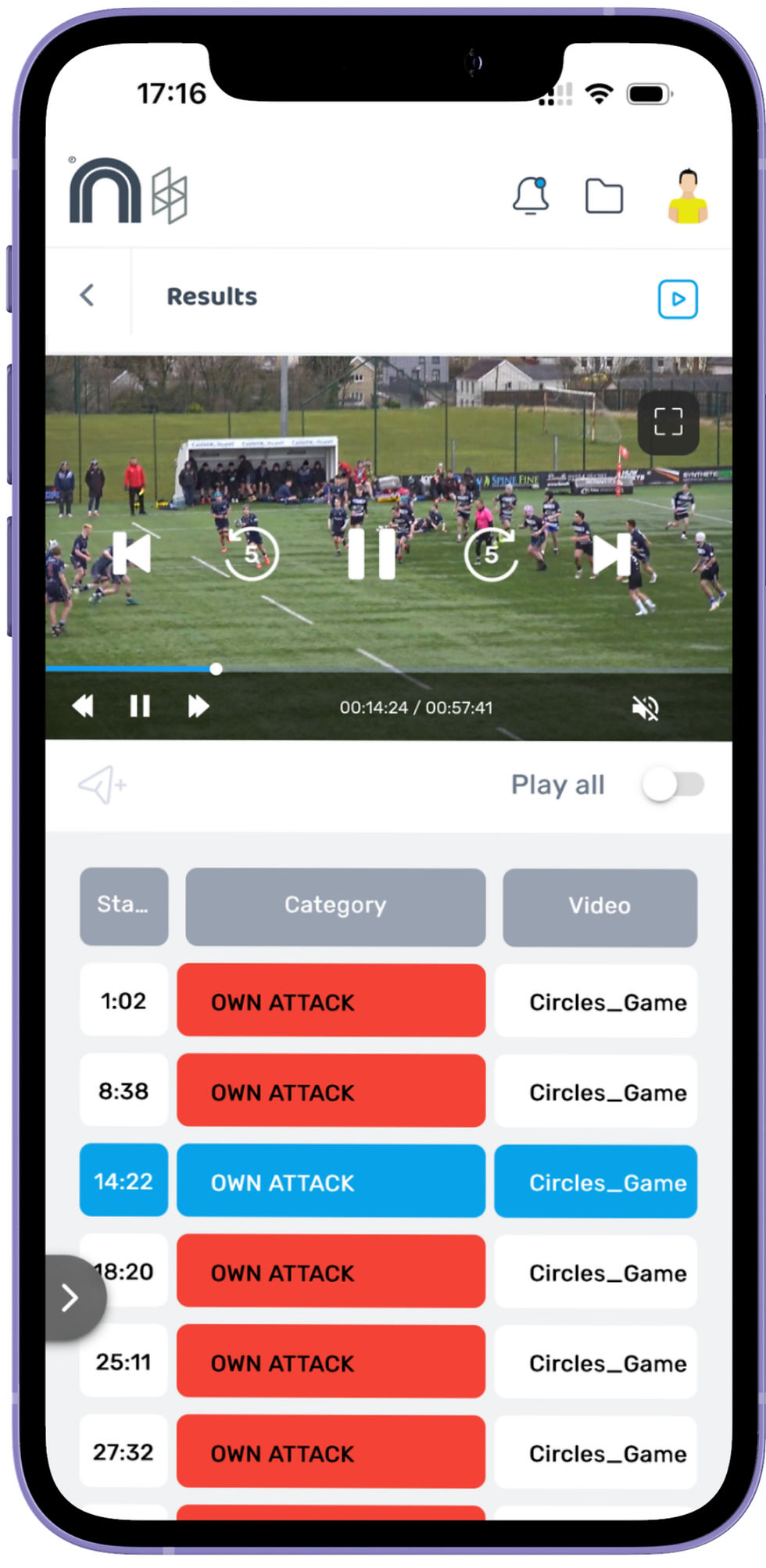
Navigate backwards through the circles. For each player moment, do not start the clip at the point of contact. Scrub back. Where was this player ten seconds out? Five? Were they already moving into position, or reacting late? This is the step that makes self-review genuinely demanding rather than comfortable. A key benefit early in this process will highlight their pace around the field.
Use the coaching language the squad already knows. The questions a player asks at each circle should come from what they have already been taught. The framework does not introduce new demands. It checks whether what is being taught in training is actually showing up in match decisions.
Grade at the Contact Circle only. The 1 to 4 score applies when a player is at or arriving at Zone 1. The outer zones are reviewed through conversation, not scores.
The coach facilitates, not narrates. Whether a player reviews independently first or works through it with a coach present, the coach's job is to ask questions, not supply answers.
The Circles of Decision-Making Beyond Rugby
The framework works in rugby because tackles, rucks, and set-piece transitions create clear individual moments to review. The same logic applies to other invasion sports. In football, the circles map to pressing triggers, defensive shape, and runs beyond the ball. In hockey, to penalty corner defence, press traps, and counter-attack positioning. The distances and coaching language change by sport. The principle of reviewing a player's decision-making in the approach to each moment does not.
The bigger picture
What this framework builds, over time, is a player who examines their own performance critically. When players know their review covers not just the tackle but the fifteen seconds before it, and that they will be the ones answering the questions, their relationship with footage changes. They stop using it as a record of what happened and start using it as evidence of how they think.
That shift is what develops tactical intelligence. The Circles framework gives coaches a repeatable, footage-backed method for making it happen.
Take it into your next session
We have put together the Circles of Decision-Making Quick Guide, a one-page reference for a coach's clipboard or tablet. It covers the three-zone framework, the self-review questions for each circle, and a step-by-step workflow for setting it up in Nacsport.
Download the Quick Guide below and start building a culture of thoughtful self-review.
Comments